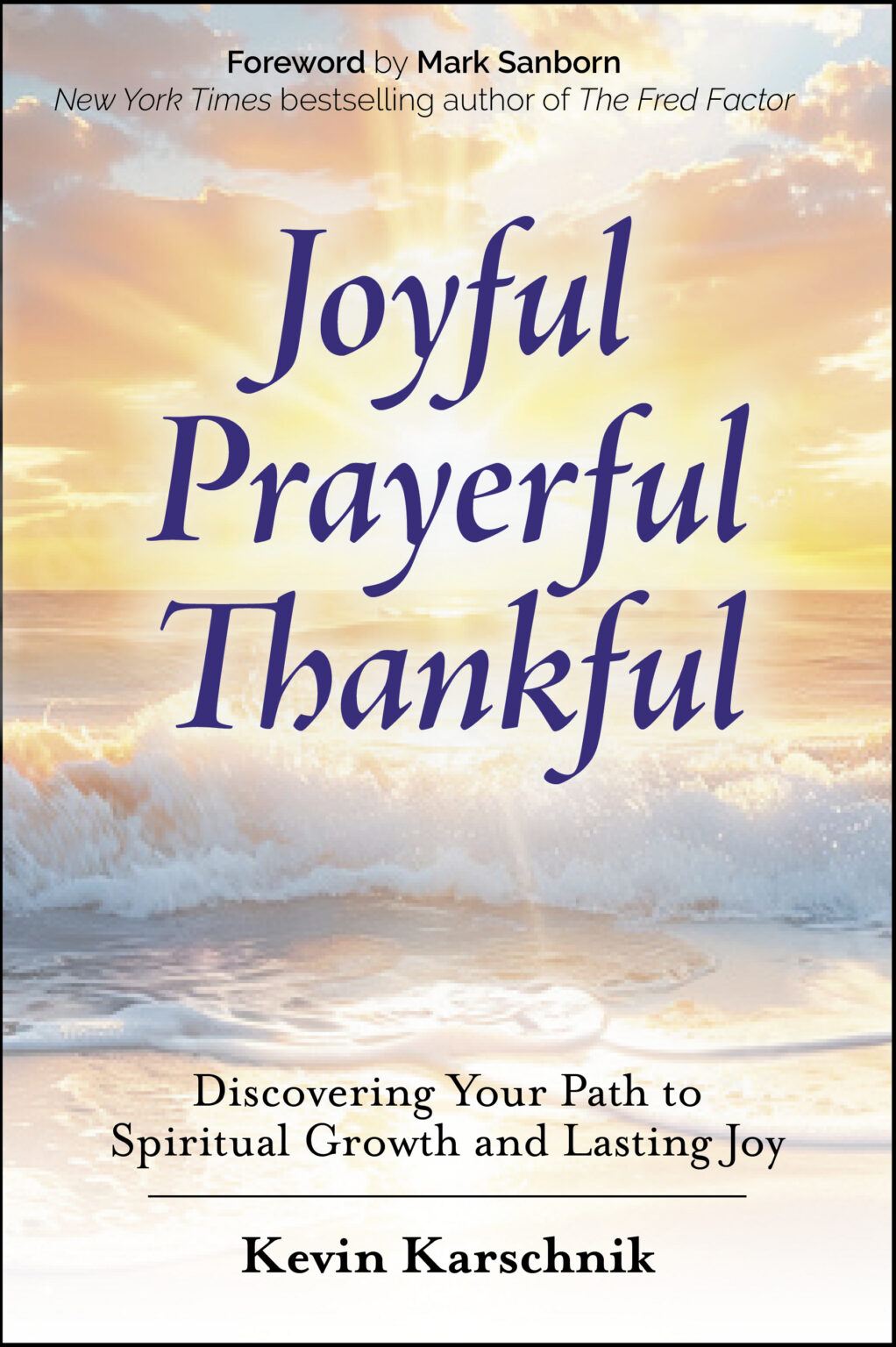
Foreword by Mark Sanborn
New York Times bestselling author of The Fred Factor, Mark Sanborn opens the book by noting that the people who truly thrive in life are not always the smartest or most talented — they are the ones who stay grounded in purpose and anchored in what matters most. He describes Joyful Prayerful Thankful as not lofty theory but practical, personal, and deeply rooted in lived experience. "This isn't the kind of book you read once and put on the shelf," Sanborn writes. "It's a book to return to often."
Book Structure Overview
The book is organized into five chapters, each built around one of five foundational words — Purposeful, Joyful, Prayerful, Thankful, and Mindful — with each chapter containing multiple stories, frameworks, Scripture, research, and practical action steps called MAP (My Action Plan).
Chapter 1: Purposeful
Before we can live with joy, prayer, and gratitude, we must wrestle with the deeper question: Why are we here? Purpose is the foundation. Without it, we drift. With it, we move through life with intention, clarity, and direction.
Key Stories and Lessons:
Key Stories and Lessons:
• Searching for Gold — The 1849 Gold Rush as a metaphor for finding purpose. Some people find their calling quickly (like Kevin's son Kip, who knew he wanted to be a CFP after a college internship). Others, like Kevin's daughter Kait, take a leap of faith (leaving a paralegal career to become a teacher and coach). The lesson: purpose often takes persistence, and God is present in every season of the search.
• What on Earth am I Here For? — Kevin's sophomore year at the University of North Texas, when professor Dr. Massey asked him point-blank what he planned to do after graduation. A Yogi Berra quote and an unexpected moment speaking to the Marketing Club lit something inside him. "I wanted to spend my life in front of people — not to chase applause, but to make a difference."
• Missing Puzzle Piece — Tracy's jigsaw puzzles as a metaphor for the season when Kevin felt something was missing despite outward success. The missing piece wasn't about what he was doing — it was about why.
• Don't Use a Hammer — A DIY plumbing disaster (a cracked Corian countertop) illustrates the danger of forcing purpose. Just as Kevin grabbed a hammer to "help" a stuck faucet — at great expense — we often try to force God's hand when things don't happen on our timeline.
• Obsessing Over Sleep — Kevin's Oura Ring experiment and "orthosomnia" (anxiety about sleep that worsens sleep) mirror how we can chase purpose so anxiously that we miss it. The concept of "ironic process theory" and the invitation to be still.
• Never Too Old — Caleb at 85 years old still claiming his mountain. Colonel Sanders, Ray Kroc, Michelangelo, and Noah as examples of late-life purpose. "If you're still alive, you haven't completed what you were put here to do."
• Go West — A Singapore taxi driver's response to Kevin's destination of "west" — "Sir, west is a direction, not a destination" — changed how Kevin thought about success. Moving without intention is not the same as living with purpose.
• What is a Meaningful Life? — Arthur Brooks' three pillars of meaning from his Atlantic work: Coherence, Purpose, and Significance. These align perfectly with 1 Thessalonians 5 — joy, prayer, and thankfulness as God's blueprint for a meaningful life.
• Be a River, Not a Lake — The Sea of Galilee (gives water, full of life) vs. the Dead Sea (takes in everything, gives nothing) as a picture of purposeful living. Kevin's honest admission: he's been better at giving his time and talent than his treasure.
• Foundation Stories (Sears Tower / This is a Football / Start with the Foundation) — The Chicago Sears Tower's underground foundation (enough concrete for a five-mile highway) as a metaphor for building a life on unseen but essential things. Vince Lombardi's "Gentlemen, this is a football" moment at the 1961 Packers training camp illustrates returning to the basics. Dave Ramsey's baby steps and CrossFit's fitness pyramid are used to illustrate how foundational disciplines — joy, prayer, and thankfulness — are the base layer of everything else.
• Bamboo Tree — Kevin's business career (Ballooners in college → IBM rep → Dell → FutureTech → iSpeak → keynote speaker) as a bamboo tree growing unseen for years before exploding upward.
• The Power of Yes — Moses' hesitation at the burning bush and Kevin's own "Who am I to do that?" moment before his first international keynote. Saying yes to God's call, even before feeling ready.
• Well Done Faithful Servant — The goal of hearing Matthew 25:23 at the end of life. Faithfulness is measured not by platform or fame, but by stewardship of time, talent, and treasure.
• Pillars of Purpose — The chapter closes with a clear framework: Joy anchors our hearts, Prayer keeps us connected, and Thankfulness reminds us how blessed we already are. Together, they form the foundation for a purposeful life.
Key Frameworks Introduced:
• Arthur Brooks' three pillars of meaning (Coherence, Purpose, Significance)
• Dave Ramsey's Baby Steps as an analogy for life's foundational disciplines
• CrossFit's Fitness Pyramid as a model for layered growth
Chapter 2: Joyful
Joy is not a fleeting mood or burst of excitement. It is a deep, steady gladness that flows from a relationship with God, not from circumstances. This chapter explores how to cultivate joy that cannot be purchased, stolen, or faked.
Key Stories and Lessons:
• The Price of Positivity — Kevin loses his favorite, perfectly broken-in Cubs hat to the ocean at South Padre Island and spends the afternoon in a self-inflicted pity party — only to learn Tracy found an identical replacement on Amazon for $25. The lesson: Kevin had an embarrassingly low "price" for his positivity. Now he asks: "Is this worth the price of my joy?" Every morning, God deposits 86,400 seconds into your account.
• Feel All the Feels — Kevin's mom's passing, the Longhorns' playoff loss, and two hip replacements — real examples of moments Kevin did not feel positive. This section pushes back on toxic positivity. Emotions are signals, not enemies. Psychologist Susan David's "emotional agility." The importance of being a thermostat, not a thermometer. ANTs (Automatic Negative Thoughts).
• Control the Controllables — A pickleball tournament in Galveston in brutal wind conditions taught Kevin to focus on his Circle of Control (from Covey) rather than external conditions. Psychologist Julian Rotter's "locus of control."
• Beyond the Gate — A Disney World family vacation used as a metaphor: What if you got to the entrance of the Magic Kingdom and then went home? Many of us are living at the gate of the abundant life God has prepared.
• Brighten a Room — "We've all met someone who can brighten a room… by leaving it." Researchers Christakis and Fowler found that emotional states can influence spouses by 8%, neighbors by 34%, and coworkers by 20%. Russ Peterson Jr.'s reminder: "We're not just shaped by others; we're shaping them too."
• Time in the Market — Kevin's son Kip's investing wisdom applied to joy: it's not about timing the market, it's about time in the market. The difference between hedonic happiness (fleeting) and eudaimonic happiness (lasting). Martin Seligman's PERMA model.
• Dance Before the Lord — King David dancing before the Ark of the Covenant with abandon. Kevin's honest confession: he had yelled "Texas Fight!" at 100,000 fans at Darrell K Royal Stadium but for years hesitated to sing out loud in church.
• Let Go of the Banana — South African monkey traps (the monkey can't let go of the banana to escape) applied to the relationships, investments, projects, and ways of thinking Kevin has held too long. "An open hand is the posture of both surrender and receiving."
• The Rhythm of Joy — Kevin's 500-mile Camino de Santiago walk in June 2025 as a living example of yin (stillness) and yang (movement) in balance. His natural default to yang (go, achieve, accomplish) and the discipline of Yutori — a Japanese concept meaning the conscious act of slowing down.
• Live Your Values — Kevin's core values: Faith, Family, Optimism. His Core Value Statement: "I am faith and family driven, and I lead with optimism to achieve success." The moment he accepted a speaking gig in Boston that cut into a South Padre Island vacation with Tracy — and felt the tension of living against his stated values. Brené Brown: "Living into our values means we do more than profess them, we practice them."
• The Wheel of Life — A practical tool (credited to Paul J. Meyer, 1960s) for assessing 8-10 life areas on a 1-10 satisfaction scale: Health & Fitness, Work & Career, Hobbies & Fun, Emotional Well-being, Finances, Faith, Family, Friends, Learning. Kevin's honest admission: when he first used it, work and finances were strong; hobbies, exercise, and healthy eating were nearly zero.
• JAMSSS Morning Routine — Developed after Kevin's kidney transplant in 2001, when Dr. Robert O. Morgan told him "Your attitude will play an important role in how well you recover." Dr. Sonja Lyubomirsky's research: up to 40% of long-term happiness comes from intentional daily activities.
o J — Journal: Three daily prompts: I am looking forward to… / I am grateful for… / I will let go of… Kevin also writes gratitude on colored paper and places it in the Gratitude Jar Tracy bought for him, Kip, and Kait. Research: Dr. James Pennebaker on expressive writing; Dr. Robert Emmons on gratitude journaling. MAP: 3 minutes each morning.
o A — Aim: Setting one to three daily intentions before opening a laptop or phone. Martha Beck's visualization of your "perfect day." Research: Frontiers in Psychology on intention-setting and the prefrontal cortex. MAP: Write intentions, then visualize.
o M — Mindfulness: A Mason jar of muddy water settling overnight as a daily reminder: the mind also needs stillness. Box Breathing (4-4-4-4) and 4-7-8 Breathing. Morning coffee on the back patio, no phone. Harvard research on mindfulness and gray matter. MAP: Start with 3 minutes of focused breathing.
o S — Stretch: 10 minutes of light stretching (static and dynamic). Dr. Beth Frates (Harvard) on stretching as a morning mood booster. MAP: Three stretches, near a sunny window if possible.
o S — Sunshine: Dr. Andrew Huberman (Stanford): 10 minutes of natural sunlight before 10 a.m. improves mood, alertness, and sleep. Kevin uses a light therapy lamp on rainy days. MAP: Step outside with coffee for 10 minutes, no sunglasses.
o S — Smile: Even a forced smile triggers dopamine, serotonin, and endorphins. The facial feedback hypothesis. Kevin's practice of "Laughter on Purpose" — intentionally seeking something funny every day. Uppsala University: smiles are contagious. MAP: Smile at three people before lunch.
• Pass It On (Kindness) — The balloon classroom experiment: when students tried to find their own balloon, chaos. When told to find any balloon and give it to that person, every student had their balloon in minutes. Dr. Sonja Lyubomirsky: acts of kindness can increase happiness by as much as 46%. Kait's mission trip to Guatemala to build a water well — "I had never felt so tired and yet so full of joy at the same time."
• Happy Habits (10 Proven Practices):
1. Move Your Body — Shawn Achor: exercise "acts like a gateway drug to happiness." Kevin's post-transplant walks that eventually became pickleball and then the Camino. The 20-Second Rule for reducing activation energy. MAP: 20 minutes daily.
2. Eliminate Joy-Drainers — Gretchen Rubin: sometimes the fastest path to happiness is removing what weighs you down. Kevin's word of the year: Yutori. The difference between pruning (freeing) and quitting (avoiding growth).
3. Savor the Small Wins — Martin Seligman on savoring. The "100 Happy Days" photo practice. Combating the "I'll be happy when…" hedonic treadmill.
4. Weightless (Music) — The song Weightless by Marconi Union reduces anxiety by up to 65% (Mindlab International). Kevin's high-energy playlist for a mood boost. Neuroscience: music increases dopamine. MAP: Two playlists — one calming, one energizing.
5. The Power of the Pause — Kevin's personal burnout experience from over-committing. JOMO > FOMO. Dr. Andrew Huberman's "ultradian rhythm" (90-120 minutes of productivity followed by 10-15 minutes of rest). Jesus withdrew often to pray.
6. Forest Bathing — Shinrin-yoku (Japanese forest immersion). Attention Restoration Theory (Kaplan). Kevin's "Quiet Walking" practice on neighborhood trails — no phone, no podcast, just nature. MAP: 20 minutes outside, one sense at a time.
7. Seven Types of Rest — Dr. Saundra Dalton-Smith's framework: Physical, Mental, Emotional, Social, Sensory, Creative, and Spiritual rest. Sleep alone cannot refill every tank.
8. Contemplate Death Daily — Bhutan: people are encouraged to think about death up to five times a day — not morbidly, but as a reminder that life is precious. Dr. Daniel Amen on writing your own funeral. Kevin's practice of visualizing his 90th birthday.
9. Pet Your Pet — Washington State University: 10 minutes petting a dog or cat can measurably lower cortisol. Kevin's daily connection with Zoe, the family Shih Tzu. MAP: Build a daily "pet break."
10. Acts of Anticipation — Dopamine released in the anticipation of a positive event. Kevin's travel planning and new-experience habit. Neuroplasticity through learning new skills. MAP: Schedule one thing to look forward to; try one new thing in the next 30 days.
Key Frameworks Introduced:
• JAMSSS (Journal, Aim, Mindfulness, Stretch, Sunshine, Smile)
• Circle of Control (Covey)
• PERMA Model (Seligman)
• Wheel of Life (Paul J. Meyer)
• 10 Happy Habits
Chapter 3: Prayerful
If joy is the fuel that keeps us moving, prayer is the GPS that keeps us on course. Prayer is not a ritual to check off — it is a relationship to lean into. Not an event, but a conversation. Not a wishing well, but a daily walk with God.
Key Stories and Lessons:
• Prayer Happens — A Pew Research survey: 68% of people pray outside formal religious services. Prayer is everywhere — in cars, hospital rooms, kitchens, locker rooms.
• Hi Mom! — Kevin's mother texted him almost every day before she passed in late 2023. Short messages: "Hi," "I love you," "Come over for spaghetti sauce." Not about information — about connection. That's exactly what "pray continually" (1 Thessalonians 5:17) means. Prayer is the spiritual Wi-Fi that stays on in the background. It's like Kevin's marriage to Tracy: even when apart, she shapes his mood and choices.
• Small World, Big God — Kevin at Disney World as a 10-year-old, tossing a quarter into the It's a Small World lagoon and making a wish. The lesson: prayer is not a wishing well. It's not a last-resort lottery ticket locked behind "Break glass in case of emergency." It is a continual conversation, in good times and bad.
• Pray Like a Tax Collector — The parable of the Pharisee and the tax collector (Luke 18:9-14). The Pharisee recited his résumé; the tax collector simply said, "God, have mercy on me, a sinner." Jesus said the tax collector went home justified. God is not impressed by credentials — He is moved by confession. Max Lucado: "Our prayers may be awkward… but since the power of prayer is in the one who hears it, our prayers do make a difference."
• Island Faith — A fictional parable about two shipwrecked men on a deserted island. The man whose prayers were all answered discovers that the other man's only prayer was: "Lord, please answer his prayers." The lesson: sometimes the most powerful prayer we can pray is for someone else's blessing.
• The Candy Man Can — Young Greg at an old-time candy store refuses to grab a free handful when offered. Why? "Because his hands are bigger than mine." Kevin's takeaway: God's hands are always bigger. He can do far more than we can hold in our own grip.
• Big Mac Prayer — Kevin's son Kip, age 10, sitting in church during Kevin's sermon on prayer, interrupts with: "Dad, you should call it a Big Mac Prayer!" A prayer sandwich — morning, midday, and night — just like the Big Mac with its extra slice of bread in the middle.
• Break Loose — The Lincoln Park Zoo and Baby Elephant Syndrome: baby elephants trained by a rope eventually grow powerful enough to snap it but never try — because they've internalized the lie that they can't. Prayer exposes those false stories and replaces them with God's truth.
• Biking with Jesus (borrowed parable) — A beautifully written allegory about moving from the front seat of a tandem bicycle (where we control the route) to the back seat (where we trust Jesus to steer). Wild detours, steep climbs, frightening speeds — and a growing trust in the One who knows the way.
• Fishing with Jesus — Two fishing stories from the Gospels: the first (Luke 5), when disciples fish all night and catch nothing before Jesus shows up; and the second (John 21), after the resurrection, when it happens again. The difference: the second time, they recognized His voice faster. Once God shows up miraculously in your life, it's easier to trust Him the next time.
• Daniel's Powerful Prayer — Daniel prayed three times a day even under threat of death. His prayers were consistent, heartfelt, and aligned with God's will. "Daniel's life reminds us that prayer doesn't always change our circumstances — but it always changes us."
• Hallelujah — The Hebrew word's meaning: hallel (praise) + Yah (Yahweh) = "Praise the Lord." From the Hallel Psalms (113-118) to the Last Supper hymn to the roar of heaven in Revelation 19:1 — hallelujah is a declaration that God is good in every season. Neuroscience: expressions of gratitude and praise boost dopamine and serotonin, literally reshaping the brain.
• God Box (from Anne Lamott's Help, Thanks, Wow) — Writing a worry, folding it, and dropping it in a box set aside for God. Kevin's daughter Kait used Guatemalan Worry Dolls in middle school with a similar effect. The God Box: not just a container, but a confession of trust.
• Learning to Pray — George Buttrick's 1942 book Prayer and his "simple regimen": stillness, gratitude, confession, intercession, and adoration/listening. Pastor Rick Warren's four ways God answers prayer: Go (yes), No (wrong request), Slow (right request, wrong timing), and Grow (right request, character not yet ready).
• Prayer Pathways — Tools for structuring prayer, including:
o Pastor Chris Hodges' Five Ps: Priority, Place, Plan, Power, Person
o Breath Prayer: Pairing slow breathing with short Scripture-based prayers (inhale: "Lord, You are my shepherd" / exhale: "I have all that I need")
o The meaning of Amen (Hebrew: "so be it" — confidence, not doubt)
• Prayer Models (12 Frameworks):
1. ACTS (Adoration, Confession, Thanksgiving, Supplication)
2. PRAY (Praise, Repent + Rejoice, Ask, Yield)
3. PAST (Praise, Acknowledge Good, Supplication, Thanksgiving)
4. ABCD (Adoration, Blessing, Confession, Desire)
5. HEART (Honor God, Examine, Ask, Request for Others, Thank)
6. STOP (Silence, Thanksgiving, Offer Requests, Pray for Others)
7. 5 Finger Prayer (attributed to Pope Francis)
8. Prayer Hand
9. The Examen (St. Ignatius, 1522)
10. The Lord's Prayer Framework (Matthew 6:9-13)
11. B.L.E.S.S. (Body, Labor, Emotions, Social, Spiritual)
12. TRIP (Tim Keller: Thanksgiving, Repentance, Intercession, Purpose)
Key Frameworks Introduced:
• Big Mac Prayer (morning, midday, night)
• Five Ps of Prayer (Chris Hodges)
• Breath Prayer
• 12 Prayer Models
Chapter 4: Thankful
Gratitude is not the same as happiness. Happiness depends on what's happening; thankfulness depends on where your heart is focused. Paul commands "give thanks in all circumstances" — not for all circumstances. This chapter is built around the conviction that gratitude is a spiritual discipline, a source of resilience, and a pathway to joy.
Key Stories and Lessons:
• Happy Thanksgiving — The Pilgrims' first winter (seven times more people buried than homes built; five kernels of corn per person per day) and yet they gave thanks. The tradition of placing five kernels on each plate. George Washington's 1789 proclamation.
• Thankful Paul — The Apostle Paul: imprisoned, beaten, whipped, stoned, shipwrecked three times, hungry and cold — and yet his letters overflow with thanksgiving. He didn't wait for better circumstances; he let gratitude reshape the circumstances he was in. Stephen Colbert: "If you're grateful for your life, then you have to be grateful for all of it."
• Give Thanks — Dr. Robert Emmons' research: consistent gratitude practitioners report stronger immune systems, lower blood pressure, more joy, and deeper relationships. Dr. Paul Mills (UCSD): heart patients who practiced gratitude had lower inflammation and better sleep. Seligman: writing and delivering a gratitude letter boosted happiness by 10% and reduced depressive symptoms for up to a month. Kevin's kidney transplant story: waking from surgery overwhelmed with gratitude for brother Don's gift. C.S. Lewis: "We ought to give thanks for all fortune: if it is good, because it is good; if bad, because it works in us patience, humility, and the contempt of this world."
• Unlikely Gratitude — Kevin's personal list of setbacks that did not inspire immediate gratitude: moving from Chicago to Austin, not making the basketball team, failing a college course, losing money in the stock market, the kidney transplant, both hips replaced, and the painful end of a business partnership. With time and perspective, God showed him: "Thankfulness isn't about denying our pain — it's about anchoring our hope." Psychologists Tedeschi and Calhoun on post-traumatic growth. Arthur Brooks' three questions after a setback: What happened? / What did I learn? / How did it benefit me?
• There's No Crying in Baseball — Complaining as the enemy of gratitude. Dr. Rick Hanson: "The brain is like Velcro for negative experiences but Teflon for positive ones." Stanford research: habitual complaining can shrink the hippocampus. Will Bowen's A Complaint Free World. Challenge: 24 hours without complaining.
• Attitude of Gratitude — During the construction of their Georgetown, TX home, Kevin meets Antonio the painter — who sees himself not as painting walls but as "preparing a home for the family that will move into this house." The attitude of gratitude transforms ordinary work into something meaningful. Dr. Michael McCullough's research: grateful people make better decisions and show greater self-control.
• Knockout Roses — Tracy's roses on the front porch withered because Kevin never noticed them. The roses on the back porch (where they sit every morning with coffee) are thriving — because they're watered, pruned, and cared for. "The blessings you notice are the ones that flourish."
• The Magnificent Strawberry — A Zen parable: a man hanging from a vine between a tiger above and a tiger below, with mice gnawing through the vine, still reaches out and savors a single wild strawberry growing from the cliff face. Life always brings tigers and mice — but thankfulness invites us to notice the strawberries God places in our path.
• Gold Miners — Kevin's keynote question: "What do gold miners look for?" Gold. "What do they actually find most of?" Dirt and rocks. "What do they do with the dirt?" They toss it aside. Gratitude retrains the brain to see the gold.
• The Jeep Effect — The day Tracy bought a Jeep Cherokee, Kevin suddenly noticed Jeeps everywhere. The Reticular Activating System (RAS): your brain filters for what you focus on. If you focus on complaints, you'll find them. If you train it for gratitude, you'll find reasons to give thanks you once overlooked. Barbara Fredrickson's Broaden-and-Build Theory.
• A Wider Lens — Kevin and Tracy's trip to Costa Rica. A group of kids playing soccer with a battered ball, full of joy, no gadgets. Travel as a gratitude teacher. "You don't need a passport to learn this lesson — gratitude is available wherever you are."
• El Camino de Santiago — Kevin's 500-mile walk in June 2025. Day three: slowing down to walk with David, a fellow pilgrim living with MS, who quoted Ray Wylie Hubbard: "The days that I keep my gratitude higher than my expectations, I have very good days." Kevin thanking God — out loud — for sore feet, hot sun, and the ache of the journey. Stone left at the Iron Cross: "I release the race and embrace God's grace."
• Forever Green — Trees in Kevin's yard looking dead every winter, roots growing deeper underground. Gratitude in winter seasons anchors us. Kevin's own "winter season" of career uncertainty — and how those unseen years prepared him to thrive.
• Runner's High — After two hip replacements, Kevin's doctor said: only run if chased by a bear. But gratitude produces its own "runner's high." Neuroscience: gratitude activates the brain's reward pathways, triggering dopamine and serotonin. Emmons and McCullough's research on energy, optimism, and resilience.
• Three Good Things — Kevin's keynote closing practice: write three good things that happened today before bed. Dr. Sonja Lyubomirsky and Dr. Ken Sheldon: a 2% increase in happiness after one week — which compounds like interest over time. Seligman: participants reported lower depression levels lasting six months. Kevin's framework: "Shine a Light on What is Right."
The Gratitude Toolkit (8 Practical Tools):
1. Gratitude Journal — Kevin's journaling prompts. After his mother's death, helping his father journal three things in the morning and three in the evening. Dr. Robert Emmons (UC Davis): journaling people exercised more, had fewer symptoms, felt better overall.
2. Gratitude Jar — Tracy bought jars for Kevin, Kip, and Kait. Daily slips of colored paper noting one thing to be thankful for. Read aloud on New Year's Eve as a "highlight reel of joy no sports network could rival."
3. Gratitude Walk — Kevin's A–Z gratitude game on neighborhood trails. Gratitude breaths: inhale thanks, exhale thanks. Barbara Fredrickson's broaden-and-build effect.
4. Naikan Reflection — Japanese practice (Ishin Yoshimoto, 1940s) built on three questions: What have I received? / What have I given? / What difficulties have I caused? Moves gratitude from a feeling to a relational, outward posture.
5. Flip the Script — Cognitive reframing: travel delays become reading time. Work stress reframed as perspective. "What's the hidden gift here?"
6. Thank-You Cards — "30 thank-you cards in 30 days" — to clients, friends, conference connections. University of Chicago: people consistently underestimate how meaningful a handwritten note is.
7. Gratitude in Action — Rick Rigsby's ten practices: say "thank you," open doors, smile at strangers, listen more, help those who can't repay you. Emory University: helping others activates the brain's reward centers.
8. Gratitude Groups — Sharing gratitude aloud at dinner tables, team meetings, and in marriage. Research: couples who express gratitude regularly report stronger relationships and greater resilience in conflict.
Key Frameworks Introduced:
• Three Good Things
• Gratitude Toolkit (8 tools)
• Naikan Reflection
• Gold Miners framework for gratitude vs. negativity
Chapter 5: Mindful
Living with purpose, joy, prayer, and thankfulness is not meant to stay as words on a page — it is meant to become the way we live. This chapter is about turning what we've learned into daily, consistent action. Mindfulness here means living intentionally, with your heart and mind anchored in truth.
Key Stories and Lessons:
• Pancake Problems — The universal truth that the first pancake never turns out right. FAIL = First Attempt In Learning. Every new beginning is clumsy because the brain is processing dozens of new variables. Edison on 10,000 failed attempts. "Do not despise these small beginnings, for the Lord rejoices to see the work begin."
• Guitar Hero — Kip at 11, mastering Guitar Hero on expert level, saving up for a real guitar, then quitting two weeks into real lessons when it wasn't instant. Kevin's life lesson: "Everything is difficult, until it isn't." The competence curve: unconsciously incompetent → consciously incompetent → consciously competent → unconsciously competent.
• Karate Kid — Daniel-san's frustration at waxing cars and painting fences — until he realizes Mr. Miyagi had been teaching him karate all along. The small, ordinary disciplines build the foundation for strength, character, and wisdom. "Small, seemingly insignificant steps completed consistently over time will create a radical difference." (Darren Hardy)
• $8 Bottle of Water — $8 for water at Wrigley Field vs. ten cents at the grocery store. Same water, different setting. Our gifts often go undervalued — but "your worth isn't based on where you're standing; it's based on who you are in Him." Coach Bear Bryant's wallet prayer on using each day well.
• Instant Millionaire — Ira Yates, a West Texas sheep rancher about to lose his land to foreclosure in the 1920s, allowed Transcontinental Oil to drill — and struck 80,000 barrels per day. The irony: Ira had always been a millionaire; he just didn't know what was beneath his feet. We all have untapped potential. "Fan into flame the gift of God, which is in you."
• Big Things Take Time — The elephant and dog pregnant at the same time: the dog has three litters of puppies while the elephant is still waiting. Eighteen months later, the elephant responds: "I'm not carrying a puppy — I'm carrying an elephant. When my baby hits the ground, the earth feels it." Don't compare your timeline to someone else's. This story so impacted Kevin that it may inspire his next book: Do You.
• God Will Save Me (Farmer Brown) (borrowed parable) — A devoted believer who refuses to evacuate during a flood because "God will save me" — turns down emergency alerts, two boats, and a helicopter — and drowns. In heaven, God tells him: "I sent you an emergency alert. I sent you two boats. I sent a helicopter. What else were you looking for?" Faith is not passive — it is active trust. "The doors don't open until you move."
• Prayerful Action (Nehemiah) — Nehemiah, cupbearer to King Artaxerxes of Persia, weeps over Jerusalem's broken walls, then acts: he prays, makes a bold request to the king, arrives in Jerusalem, inspects the damage, rallies the people, and rebuilds the wall in 52 days despite mocking and threats. Prayer and action are not opposites — they are partners. Kevin's application: "For me, this book is that example. I spent more than five years thinking about it. But the thinking wasn't finishing the book."
• The Widowmaker — White-water rafting in Buena Vista, Colorado to celebrate Kait's high school graduation. Guide Zach presents three options for the Widowmaker rapid: Plan A (paddle hard, punch through), Plan B (get pushed aside into a whirlpool and watch others pass), or Plan C (topple and drift). They hit it head-on. "Life will hand you Widowmakers. Don't get stuck in the whirlpool."
• Be a Buffalo — Colorado cows run away from storms and end up trapped in them longer. Buffalo charge into the storm and pass through it faster. Be the buffalo. Face life's challenges with courage and faith instead of avoidance.
• Eggs and Ham — A hen and pig overhear a fundraising appeal. The hen suggests giving eggs and ham. The pig objects: "For you, that's a contribution. For me, that's total commitment." The difference between interest (doing something when convenient) and commitment (accepting no excuses).
• Build With Care — Chuck the carpenter, ready to retire, reluctantly builds one more house — cutting corners and using cheap materials. His employer hands him the keys at the end: "This is your house. My gift to you." If we'd known we were building our own house, we would have done everything differently. "You are the carpenter."
• Keep Your Left Elbow Straight — A golf lesson in Kevin's 40s. Trying to fix everything at once made him worse. One simple tip — "keep your left elbow straight" — made his shots straight enough to play a round with Kip. Progress starts with one focus, one adjustment, one step. "If everything is important, then nothing is." (Lencioni)
• Baby Steps — Dr. Paul Gates, Kevin's orthodontist, refusing to double up on rubber bands: "There are no shortcuts. Moving teeth takes time." Nine months of daily micro-adjustments produced results. James Clear (Atomic Habits): "Success is the product of daily habits, not once-in-a-lifetime transformations."
• Whirley Pop — Kevin making popcorn for a movie night but getting nothing — because he forgot to turn up the heat. The kernels were in the right pan, with the right oil, on the right stove. Sometimes we don't need a new plan; we just need more passion. Angela Duckworth on grit. "Popcorn cooks in the same pot, in the same oil, on the same stove — but the kernels don't all pop at the same time. Don't compare your timing to others."
• One Drop — The hardest part of any task is just getting started. One push-up. One sentence. One verse. One step out the door. The Zeigarnik Effect: starting creates its own pull. Kevin on the Camino: "I didn't focus on Santiago — I just aimed for the next village." Kevin on this book: "I started with one page." Dr. Seuss writing Green Eggs and Ham using only 50 different words.
• Wheel of Change — Marshall Goldsmith's four-quadrant framework for growth:
o Keep — What's already working? Protect it.
o Let Go — What's weighing you down? Prune it.
o Accept — What can't be changed? Find peace.
o Create — What is God nudging you toward? Step forward.
Paired with the Japanese concept of Kaizen (good change / continuous improvement): small, steady steps that compound into transformation.
Key Frameworks Introduced:
• Wheel of Change (Goldsmith: Keep, Let Go, Accept, Create)
• Kaizen (continuous improvement)
• Competence Curve
• The Widowmaker (Plan A, B, C for life's challenges)
Praise for Joyful Prayerful Thankful
Don Forrester, Executive Director, Coalition of Residential Excellence (CORE)
"Brilliant. Insightful. Compelling. Kevin’s words are nourishment for the soul. Joyful Prayerful Thankful is more than a book—it is a faith-based tutorial for life, woven with wisdom, transparency, and personal stories that are both inspirational and practical. You can’t read it without reflecting on your own life and discovering a roadmap for living with greater joy, prayer, and thankfulness."
Anne Grady, Keynote Speaker and Author of Mind Over Matter: Harness the Power of Resilience
“Joyful Prayerful Thankful is a much-needed reminder to pause and focus on what truly matters. Kevin’s heartfelt stories and practical wisdom demonstrate that joy, prayer, and gratitude are daily choices that can profoundly transform our experience of life. His message is clear—the goal isn’t to fake positivity, but to experience real joy, meaningful connections, and gratitude that lead to a more intentional and fulfilling life. This book is encouraging, actionable, and one I’ll return to whenever I need to reconnect with what matters most.”
Reid Ryan, President and CEO, Round Rock Express Baseball Club & Ryan Sanders Baseball
“In this crazy fast paced world today, Joyful Prayerful Thankful is a much-needed invitation to slow down and return to what matters most. Kevin writes with warmth, wisdom, and authenticity. This book is worth your time.”
Cheryl Graham, Learning & Development, Leadership Development Program Manager, 7-Eleven
“Beautifully written and deeply meaningful, Kevin’s reflections in his book Joyful Prayerful Thankful offers a refreshing perspective on where true joy is found in our connection with Christ. This is the kind of message I’ll carry with me and share with those who need a gentle reminder of hope.”
Bill McAlpine, Executive Leadership and Performance Coach
“The Old Testament recounts the story of King Solomon’s desire for Godly wisdom. And scripture tells us he ruled for many years in that wisdom. Self-awareness is the first step towards wisdom and wisdom produces something of value. Kevin’s book is filled with truths and stories based on that type of wisdom. Savor it, take your time and enjoy the truths that pour out of the pages of Joyful, Prayerful, Thankful. It is filled with practical, personal and thoughtful wisdom.”
Dr. David W. Smith, Executive Director, Austin Baptist Association
“Kevin’s words spoke to my heart with both simplicity and depth. In a world that constantly pulls us toward hurry and distraction, Joyful Prayerful Thankful felt like a gracious call to slow down and lean into what truly matters: not chasing achievement, but aligning with the One who gives our life purpose. Kevin writes with such warmth and authenticity that it feels less like reading a book and more like sitting across from a trusted friend. His stories and insights are practical and encouraging, pointing us toward a life of purpose, peace, and lasting fulfillment.”
Alicia Davis, Director of Global Finance L&D, Dell Technologies
“Joyful Prayerful Thankful is a guide that invites you the reader to embrace and incorporate you faith as a source of peace, happiness and calmness. Through heartfelt reflections, shared stories and practical insights, you gently lead toward a deeper or renewed connection with your inner self and a more joyful, prayerful, and thankful life. A must read for those seeking simple steps to growth and success based on your values.”
Dr. Lauren Hodges, Keynote Speaker, Author of Less Stress, More Calm: Discover Your Unique Stress Personality and Make It Your Superpower
"Blending timeless wisdom with modern relevance, Karschnik draws on performance psychology, research, and parable-style storytelling to show how joy, prayer, and gratitude are not just spiritual practices, but essential skills for thriving in both life and work. Highly recommend the read for all phases of life!"
Brian Thomson, Manager, Learning & Development, CMC
"Thought-provoking, enlightening, and actionable. Kevin has nailed it again in Joyful Prayerful Thankful. His warmth and wisdom lights a righteous path for all to follow.”
Russ Boles, County Commissioner, Williamson County
“In a world where the problems of the day are constantly pushed in front of us, it’s easy to overlook the countless things that are going right. Joyful Prayerful Thankful offers a way to cut through the noise, refocus on the positive, and rediscover just how amazing your life truly is.”
Debbie Rippstein, President, Texas Baptist Children's Home
“Kevin’s book is filled with ‘aha’ moments that stopped me in my tracks and invited me to reassess where I am in my own life. His words are both challenging and encouraging, pointing me back to the source of true joy. This is a book I’ll return to again and again.”
Hannah Terrell, Director of Libraries, Austin Public Library
“Joyful Prayerful Thankful is a must-read. Kevin pours decades of professional experience, personal growth, and a deep commitment to helping others into every chapter. His wisdom is both practical and inspiring, offering readers a roadmap to embrace a growth mindset rooted in gratitude and faith. He leaves a gold nugget on every page—insights that will challenge, uplift, and transform. This book is more than a read; it’s a journey toward a more joyful, prayerful, and thankful life.”
Steve Lawton, Director, Dell Technologies and Author of Head First! A Crash Course in Positivity
“I was crazy busy and thought, I just don’t have time to read Joyful Prayerful Thankful—and I’m going to have to let Kevin down. Then I opened the manuscript and started reading. I quickly realized that it was exactly what I needed in that moment. I couldn’t put it down. Kevin’s skillful writing makes the content easy to read, easy to absorb, and easy to apply. I highly recommend this book to anyone navigating a transition in their life.”
Alycia Angle Anderson, Coach, Speaker, & Perspective Shifter
“Kevin has a rare gift for blending wisdom, warmth, and humility in everything he does. Joyful Prayerful Thankful feels like sitting down with a trusted mentor who gently reminds you what truly matters. Kevin’s words have encouraged and guided me through many seasons of life and leadership, and this book is a beautiful extension of that same heart. It’s a must-read for anyone seeking lasting joy and purpose.”