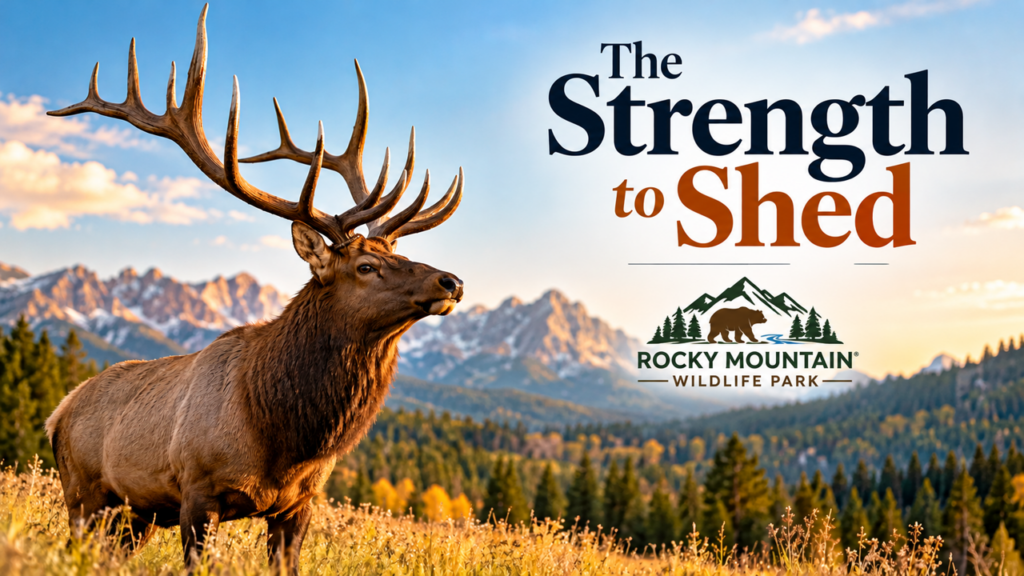
This past summer, Tracy and I were driving to go hiking near Pagosa Springs, Colorado, when we spotted a sign for the Rocky Mountain Wildlife Park. We decided to make an unexpected stop. Vicki, one of the animal caretakers, took us on a tour. She walked us from animal to animal, sharing their stories, teaching us about their behaviors, and feeding them along the way. I learned that if I’m ever attacked by a brown bear, I may need to play dead. But if a black bear attacks, I should fight back. Personally, I’m hoping to never test either strategy. 😉
I thoroughly enjoyed meeting all the animals. But one animal in particular captured my attention. His name was Cimarron, and he was a magnificent bull elk. The more Vicki taught us about Cimarron, the more fascinated I became. Every year, bull elk spend months growing magnificent antlers. They use them to compete with other males and establish dominance during mating season. And then, when the season changes, they shed them. And just like that… something that took months to grow is gone.
For a while, Cimarron is without something that had been such a visible symbol of his strength. But he isn’t losing his strength. He’s simply entering another season. Before long, a new set of antlers begins to grow. It’s not a sign of weakness or failure. It’s simply part of the natural cycle.
And that got me thinking… why is something that comes so naturally to an elk often so difficult for us? I know I struggle with letting go. How about you?
The Things We Hold On To
We spend so much of our lives accumulating things. Not just possessions, but accomplishments, responsibilities, routines, relationships, and identities. We develop ways of doing things that work for us. We build careers, develop relationships, establish habits, and become comfortable with how life operates. Many of those things helped us become who we are today.
But what happens when the things that once served us well begin to hold us back? I’ve been thinking about this quite a bit lately, particularly as Tracy and I navigate the challenges of having aging parents. It’s difficult watching people you love struggle with changes that come with getting older. Things that were once easy become harder. Independence becomes more complicated. Routines that worked for decades may no longer be practical.
And sometimes, the hardest part isn’t the change itself. It’s accepting that life can no longer look exactly the way it used to. Giving up independence or changing the way you’ve always done things can feel like losing a part of yourself. And I get that. But before I get too frustrated with someone else’s unwillingness to change, I have to ask myself an uncomfortable question: Am I really any different? Maybe I’m not resisting the same changes, but I certainly have my own antlers I’m reluctant to shed. Don’t we all?
When Success Starts Looking Different
For most of my adult life, I’ve been an achiever. I’ve enjoyed building successful businesses, speaking to audiences, facilitating workshops, writing books, and pursuing new opportunities. I love what I do and I feel like I’m pretty good at it. I’ve made a positive difference in people’s lives and I’m grateful for all the opportunities I’ve had.
But lately, I’ve been thinking about what I want the next season of my life to look like. I call it flextirement. It’s my own version of retirement, except I’m not planning to stop working completely. I still want to write, speak, teach, and preach. Those are things I genuinely enjoy, and I believe I still have something meaningful to contribute. But I don’t want those activities to dominate my calendar the way they once did. I don’t want to spend as many hours in airports or as many days preparing for the next presentation.
I want to spend more time with Tracy, Kip, Kait, and our extended family. I want to spend more time traveling just for fun, enjoying friendships, taking care of my health, deepening my faith, and simply appreciating this wonderful life I’ve been given.
It sounds good, and it seems like it should be easy. But it isn’t. I’m not sure why the transition is so difficult. Maybe it’s because I’ve spent so many years being busy, being productive, and being needed that slowing down feels a little uncomfortable. When you’ve spent decades measuring success by what you accomplish, it’s surprisingly difficult to stop keeping score. There’s always another opportunity, another audience, another project, another reason to say yes.
And saying no to something you’ve always valued can feel strangely uncomfortable. Maybe that’s one of my antlers. Not my love for speaking or writing. I don’t need to give those up. But perhaps the belief that a full calendar and another accomplishment are always signs of a successful life. I’m learning that my next season of life doesn’t have to be bigger to be more meaningful.
Letting Go Isn’t Giving Up
Cimarron doesn’t spend his life trying to preserve last year’s antlers. He grows them, uses them, and when the season changes, he sheds them. It’s part of a natural cycle.
Of course, some commitments deserve to be strengthened, not surrendered… like my top three core values: faith, family, and optimism.
But how often do we confuse holding on with being strong? We hold on to old habits because they’re familiar. We hold on to responsibilities because we’ve always been the one to handle them. We hold on to opinions because changing our minds feels like admitting we were wrong. We hold on to possessions because they remind us of who we used to be.
And sometimes we hold on to a version of ourselves that no longer fits the life we’re being invited to live. I’m beginning to realize that letting go doesn’t necessarily mean something was bad, wrong, or a mistake. It may simply mean it belonged to a different season. And that’s okay.
What Are You Ready to Shed?
I’m glad Tracy and I stopped at the Rocky Mountain Wildlife Park because I’ve been thinking about Cimarron and the lesson he taught me ever since. As I watch our parents navigate the challenges of aging, I want to remember that letting go can be frightening. I hope I can approach their struggles with more patience and compassion. And as I navigate my own transition into a different season of life, I want to remember that the things that helped me succeed yesterday don’t all need to define my tomorrow.
I don’t have to abandon the person I’ve been. I just need to be willing to grow into the person I’m becoming. Can you relate? Perhaps there’s a habit, an expectation, a responsibility, or even an old definition of success that you’ve been carrying longer than you need to. Something that once served a purpose but now occupies space that could be used for something more meaningful.
What if letting go isn’t losing something valuable, but making room for something that matters more? Cimarron will grow another set of antlers. That’s what elk do.
Maybe our next season won’t bring something bigger or more impressive. Maybe it will bring something better suited to who we are now.
And maybe that’s what growth is really about. Not always adding more. Sometimes, having the wisdom and courage to let go.